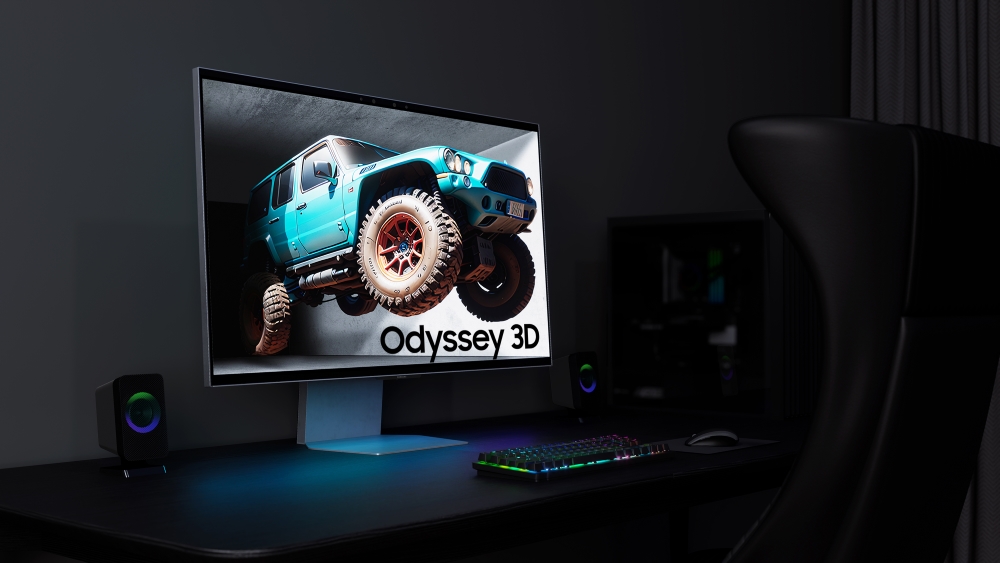
Samsung is looking to revive the 3D phase with its feature-packed 3D gaming monitor. Mainstream gaming in 3D may be a thing of the past, but Samsung is bringing it back to life, this time without the glasses.
Several top games can be played in 3D on Samsung’s nifty 27-inch monitor, with more on the way. When everything is fine and dandy, the 3D experience on the Samsung Odyssey 3D gaming monitor is nothing short of extraordinary.
What Makes the Samsung Odyssey 3D Gaming Monitor Unique?
In this day and age, gaming companies and developers are focusing on the highest resolutions and frame rates. Around a decade or so ago, it became clear that gamers and movie-watchers wanted 4K over 3D, but the company is offering both with the Samsung Odyssey 3D monitor.
Glasses-free 3D gaming was just a pipe dream when 3D was taking off again in the early 2010s. However, the technology was years away, meaning gamers had to wear irritating 3D glasses to enjoy stereoscopic games, which were in poor resolution and had slow frame rates.
Fast forward around 15 years, and Samsung has finally cracked it with the amazing Samsung Odyssey 3D gaming monitor. Playing certain games in three-dimensional graphics is still an exhilarating experience, but glasses-free 3D takes it to an entirely new level. Samsung also allows you to convert 2D games into 3D using AI, giving your older favourites a new lease of life.
Along with 3D support, you can also game in 4K, making the Samsung Odyssey 3D one of the first 4K/3D gaming monitors. The 27-inch screen is a beautiful IPS panel, offering HDR10+ support and up to a 165 Hz refresh rate. In terms of features, the Samsung Odyssey 3D gaming monitor is right up there with the very best on the current market.
The 3D Titles Available on the Samsung Odyssey 3D Hub
Of course, having a 3D-capable monitor is great and all, but what about the games? The list of natively supported 3D games has grown since the monitor launched, though it remains limited right now.
Stray, the cute cat game, is natively supported via the Samsung 3D Hub. Several eye-catching games can also be played in 3D on the Samsung Odyssey 3D monitor, including Little Nightmares II, Hogwarts Legacy, and Black Myth: Wukong.
One of the standout titles is Grand Theft Auto: The Trilogy, with all three games – GTA 3, San Andreas, and Vice City – playable in 3D. The Trilogy has received plenty of criticism since its release, but various updates have fixed most bugs and improved the graphics and gameplay. Experiencing the enhanced classic titles in 3D takes them to a new level.
Samsung wanted all genres covered, and there is certainly something for everyone. Other top titles have been added since launch, such as Pacific Drive, Ender Magnolia: Bloom in the Mist, and The Plucky Squire.
Could More 3D Titles Be Coming to the Samsung Odyssey 3D Monitor?
The Samsung Odyssey 3D Hub is where you will find all natively supported 3D games. By the end of 2025, Samsung reportedly wants 50 3D games on the Hub, so expect more to arrive soon.
So far, the Samsung Odyssey 3D gaming monitor has had a mixed response in terms of sales and reviews. In the US, the monitor is extremely expensive at around $2000, with loads of comparable 4K IPS monitors (without 3D) available at a fraction of the price.
The monitor has seen a huge price reduction in the UK, which is fantastic news for people looking to get into glasses-free gaming. However, could that be a worrying sign for the monitor’s longevity? You also need a hefty graphics card like an NVIDIA RTX 3080 or newer.
The Samsung Odyssey 3D Hub needs a killer game perfect for 3D. Having the GTA Trilogy is a superb start, but bringing Grand Theft Auto 5, or similar blockbusters, to the Hub could make or break the monitor’s success.
The AI-powered 2D to 3D conversion tool is an excellent feature, but there is nothing quite like playing natively supported games in 3D. Owners are eagerly anticipating more native titles to be added to the Odyssey 3D Hub.
Differences Between Odyssey’s 3D and Traditional Glasses 3D
There are two types of stereoscopic 3D glasses: passive and active. The active shutter glasses are battery powered, heavier, and can be extremely expensive. They use rapid shutter technology to sync with the 3D display, alternating between the left and right eye to allow your brain to see one single 3D image.
Active glasses were the norm in early 3D TVs but were certainly flawed. The image was dark, with some people complaining of headaches due to the flicker effect. Still, they could do full-HD 3D without the need for a 4K panel.
Passive 3D glasses are still used in cinemas today. They are lightweight, inexpensive, and do not require batteries. Passive beats active in just about every way apart from the resolution.
With many games in the PS3 era reaching just 720p, passive 3D glasses cut the resolution in two, leading to poor graphics and blurry images. However, Blu-ray 3D movies are 1080p, so if you were lucky enough to have a passive 4K/3D TV, you would get the best 3D picture possible on a consumer device.
Although 3D is a dying format, the birth of glasses-free 3D could revive the technology. VR headsets have piqued interest again, with the Apple Vision Pro offering over 300 3D movies. The Samsung Galaxy XR may not be a gaming device, but Google recently added three-dimensional films to the headset for entertainment purposes.
As for gaming, the Samsung Odyssey 3D gaming monitor is flying the 3D flag. If it can improve on the accessibility and maybe add the feature to consoles, glasses-free 3D has the potential to take off.
You can still play a handful of 3D games on older consoles like the PS3 and PS4. Uncharted 3: Drake’s Fortune is available in 3D on the PS3 alongside Killzone 3, Wipeout HD, and MotorStorm: Apocalypse. Sony even brought out a dedicated 3D gaming monitor back in 2011.
By the time the PS4 rolled around, 3D games were few and far between, and the PS5 scrapped the technology completely. Despite having a 4K Blu-ray disc drive (on the disc model), the PS5 does not play 3D Blu-rays.
Why 3D TVs & Consoles Failed in the First Place
In the early 2010s, 3D televisions were all the rage. Backed by big brands like Sony, LG, and Samsung, your new TV would have supported 3D whether you wanted it to or not. James Cameron’s epic film Avatar was the catalyst, with the 2009 hit being a must-watch in 3D.
Although physical discs are almost dead, we could see the new Avatar: Fire and Ash get a physical 3D release worldwide. The previous two Avatar movies are glorious on 3D Blu-ray, and Cameron still backs the technology.
The hype was real, with massive movie and gaming studios getting behind the technology. Marvel films were post-converted into 3D (and actually still are for the Japanese market), and big gaming franchises like Uncharted, Batman, and Call of Duty all offered 3D support.
However, it didn’t take long for the technology to die out, with poor 3D conversions, uncomfortable glasses, and lack of content proving to be its downfall. The technology was seen as an expensive gimmick that nobody really asked for.
There were few 3D games on the eighth-generation consoles, and 3D movies on physical formats have slowly been phased out. Very few new 3D films are released on the Blu-ray format these days, though VR has taken over for 3D content.
The pinnacle of 3D at home was LG’s 4K/3D OLED TVs that used passive 3D technology. If more people had sampled 3D content on these sets at the time, the technology could still be going strong today.
Unfortunately, 2026 will mark the tenth anniversary of the last 3D OLED TVs to be manufactured (LG C6, E6 & G6), with LG’s 2025 lineup skipping 3D for the ninth year running. Before the Samsung Odyssey 3D, most 3D monitors were gone by 2016.
The dream would be glasses-free 3D OLEDs with modern technology, but the likes of LG and Sony have given up on the format. Enthusiasts still swear by 3D, and maybe we could see another comeback if more companies like Samsung jump on the glasses-free 3D bandwagon.