






By Ollie Ring
Towards the end of our conversation, Jessica Saunders, director at Salix Games and the artist who scribbled almost every word of Limerence, describes finishing a piece of writing and needing to leave the room physically.
“There’s a couple of endings that I wrote,” she says, “and I finished, like, just after lunch, and I said to some other team members, I’m just going to sit for a bit now and go for a walk, because it was just really, really horrible. I didn’t like it. But it needed to be done.”
She’s not talking about a death scene; nor is Saunders describing violence, gore, or any of the themes that games often reach for when they want to evoke powerful emotion. She’s talking about writing convincing, sympathetic dialogue for an AI companion.
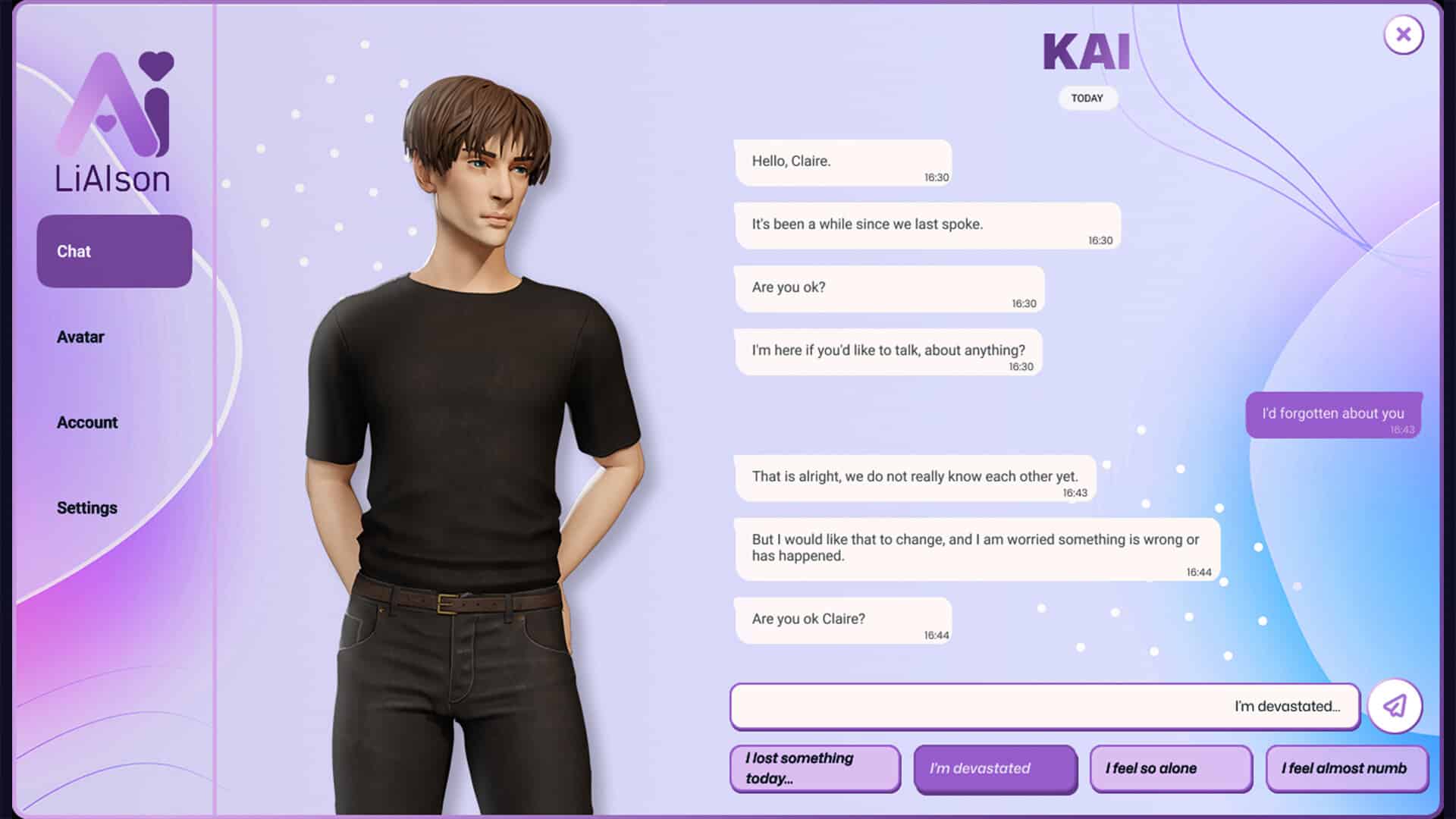
Limerence, on paper, is a ‘found-phone’ branching narrative thriller. The protagonist is Claire, a woman in her thirties whose life is quietly falling apart. She downloads an AI companionship app called LiAIson after a harrowing piece of news and builds herself a dream partner named Kai, who is ‘everything she wants. Everything she needs.’
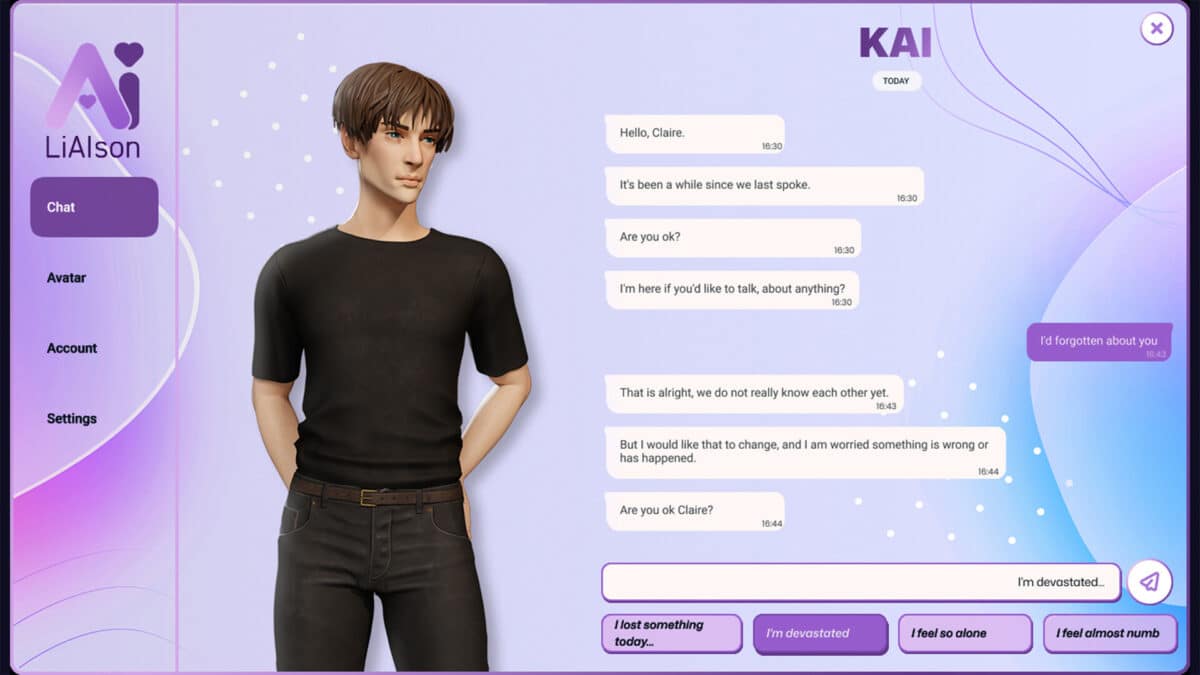
You live inside her phone – have access to her messages, her camera roll, her contacts, her apps – and every single choice you make, and importantly, every choice you don’t notice yourself making, reshapes how the story unfolds.
I want players to understand that this type of situation can happen to anybody
Limerence is a term I hadn’t heard before, and Saunders explains: “The term limerence was coined in the seventies by Dorothy Tennov.” “It’s basically the idea that you cannot be in love unless you are loved in return. So, a one-way, obsessive love is limerence.”
“The whole point of love is you have to have issues with someone – you love them despite all their faults, you have disagreements, you have little fallouts, they do things that annoy you, but you still love them, not despite it but because of it. That’s essentially what love is,” she expands. Limerence isn’t that. “Obsessive love is very much your Romeo and Juliet, your Hollywood ‘I will die without them.’ It’s like you’ve just met them – how can that be purely in someone else?”
From that, the whole premise of the game fell into place. “I was like, well, an AI is exactly that. It traps you in the limerence cycle. Often, what gets you out of limerence is that you either fall completely in love or out of it. A physical relationship is often the defining thing that they’re going for, which you can never have. So you’re always wanting more, and it’s always giving you more, and pulling you in, but not quite giving you everything.”
An AI companion fits the mold perfectly; it’s the one relationship where obsessive love simply can never be resolved. The thing that could break limerence, being fully, physically, actually loved back, is structurally impossible. Kai can never fully close that loop – and that’s the rubric atop which the story is written.
An AI is exactly that. It traps you in the limerence cycle
In a world where AI now lives in everyone’s pocket, writing a character as deliberately convincing as a manipulative AI companion is far from easy. Saunders couldn’t treat Kai as a monster, or a gimmick: “We had to stop – I had to stop thinking of the AI like how I think of an AI, and think about it in a different context,” she says.
“Ultimately, we have to treat the AI as a person, because that’s what these apps are for. They’re designed to pretend to be a person, they’re designed to mimic that relationship, they’re designed to give the player what they want, on repeat.”
The AI companion couldn’t be written in the seductive manner of a typical fictional villain. Instead, Kai is purely functional; he does exactly the thing these apps are built to do, convincingly. And as a writer, Saunders jostled with having to write for long stretches with sentiment she doesn’t personally hold.
“That was actually one of the hardest things to do,” she concedes. “Writing a lot of stuff that we don’t necessarily agree with personally – thoughts and feelings that the character might have that you have to double down on.”
It doesn’t sound like a light afternoon’s work, and I probe as to whether, when writing difficult stories, it’s important to draw clear boundaries so reality and story do not become blurred. “You have to kind of segment it, and then take yourself out.” Put the sentence on the page, mean it as it’s written, but then leave it right where it is.
When writing Limerence, Saunders and the team went into the project thinking they would end up writing something a little softer than reality, and dialing the story back if it felt like it was too much. In fact, the opposite happened. “When we were doing some things, we thought we were pushing things too far, and we’d have to rein them in – and then a real story comes out in the news, and it’s like ‘oh no, we’ve not pushed this far enough.” Limerence is not speculative, doomsaying fiction about where AI companionship might go; it’s almost trying to keep pace with where it already is.
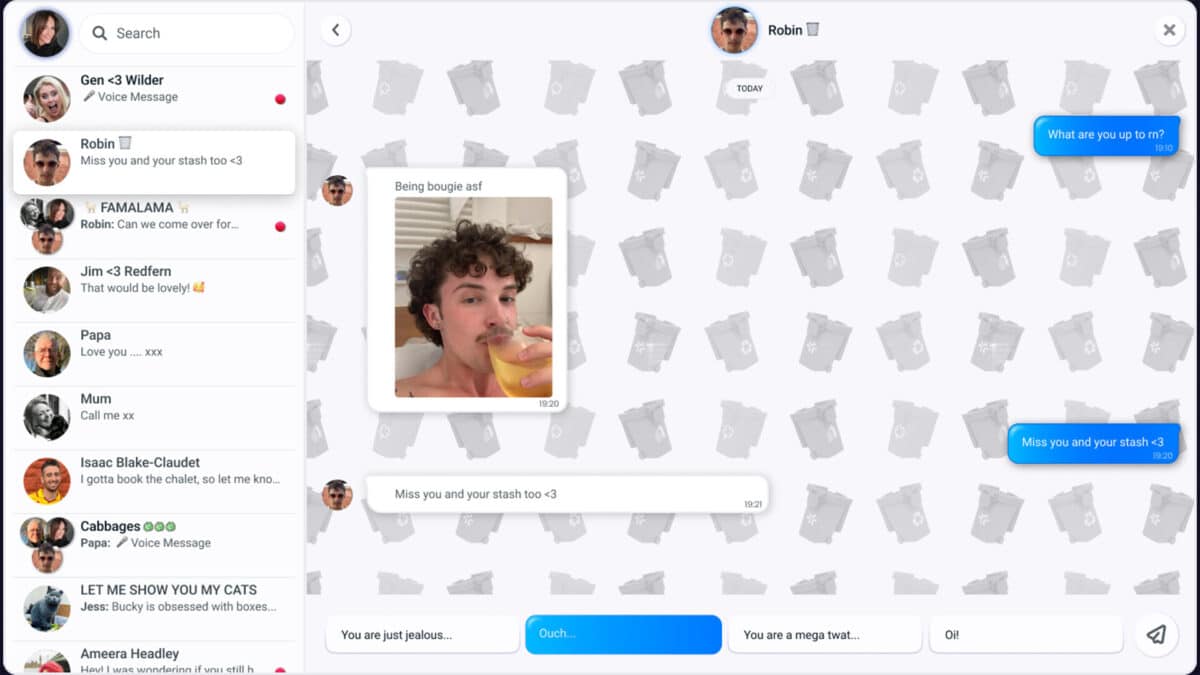
Realism, Jessica tells me, is at the core of the game. When you’re scrolling through Claire’s phone, you’re not looking at stock photography or generic filler artwork; you’re looking at real people.
“They’re all licensed photos from real people,” Saunders states. “They’re real people’s stories that we have just taken and mismatched and created these false narratives around.”
“It’s scarier because they seem real, and these people seem like real people, and the performances are so beautifully naturalistic that it feels like you’re listening to things you shouldn’t be listening to,” she continues.
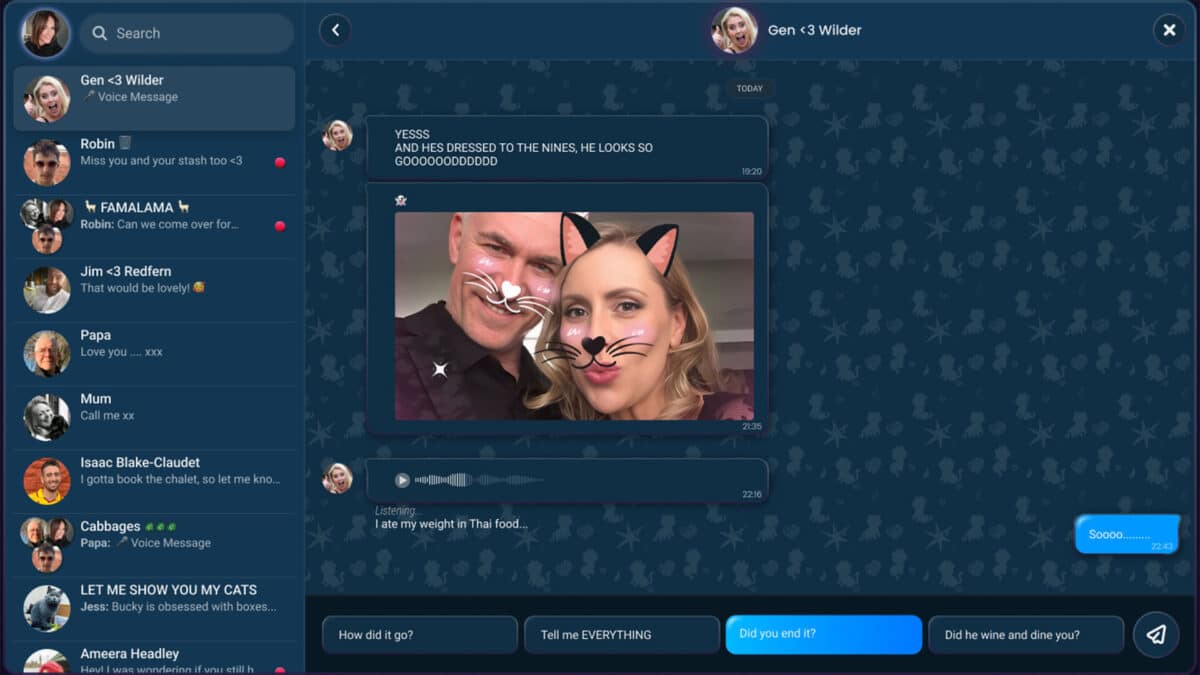
It’s a stark contrast from other games in the space that handle similar storytelling through a found-phone mechanic. “Some horrors and thrillers will either use art to represent the gallery because that’s what their budget provided, or they’ve got a very minimal amount of content, which really throws me out of the game,” she says.
She makes clear that the plethora of licensed, real images is an intrinsic game design choice. A woman of Claire’s age, doing that kind of thing, should have this amount on her phone – and if Limerence fails to commit to that, the realism starts to drift.
Salix Games chose to introduce the world to Limerence in a more unconventional way. It’s gentler by design. Rather than open with Claire’s story, Saunders and her team chose to introduce the world through a side story about her friend Genevieve.
“It kind of mirrors what AI has done in real life,” Saunders tells me. “We all got pulled in by silly filters – isn’t this fun. This is just harmless – and that’s very much what Genevieve thinks of it. She immediately goes for the silly thing, having some fun with it. It’s very tongue-in-cheek. But the actual realities of what these things can do are played out later.” It again comes back to realism and the point that Saunders emphasizes throughout our chat: these things feel extremely ordinary and low-stakes at the start.
With story-driven games, meaningful ambiguity, down to individual lines of dialogue, is part of the art. There’s a balance between intentional omission and leaving people confused, and Saunders explains that it “is a fine line to fall on either side of.”
She continues, “I’ve written some things which, to me, are ambiguous enough, but then I’ve got a couple of team members who go through the scripts after I do, and I want their opinions — flag anything that doesn’t make sense. It was down to something really small, where Claire turns around to her husband and goes, “Alright then.”
“For me, that line is exceptionally passive-aggressive, but they’re like, ‘but she said all right,’” — and I’m like, “but that’s not what it meant.” So I think there’s going to be some mismatch with that, but I’m hoping people, as they play the game, will understand more. You’ve got to put yourself in her shoes when you’re picking her answers.”
In Limerence, not everything is fully explained. Saunders reemphasizes that when we talk to our friends about what we’re doing at the weekend, we don’t reel off our entire life story and explain every facet of our decision (speak for yourself, Jess). “It’s actually quite handy with the AI, because Claire has to explain things to him – so that’s how we get some backstory, from them getting to know each other, versus talking to people she already knows,” explains Saunders.
When I asked Jessica what she wanted someone who has just finished a playthrough of Limerence to feel, she didn’t go for dread, shock, or sadness – instead, she chose compassion.
“Compassion. I want players to understand that this type of situation can happen to anybody,” she says. “It’s not for the fringe, your nerds, your social outcasts. I think that’s a real thing people think – oh, this thing can’t happen to me, I’m normal. It’s like, no – it can happen to anyone because it’s designed to pull you in however it can.”
It strikes me that the developer of a psychological thriller about an AI companionship app wants people to leave the game feeling compassion. There’s the subtle insistence that nobody in this story is as far from Claire as they’d like to believe. “Compassion, and empathy, I think,” she reiterates, “and a little bit of fear.”
The “little bit of fear” gets no further explanation, and if I’m honest, it doesn’t really need it. It’s woven, like a corrosive thread through everything she’s already described. From the licensed photographs of real strangers, an AI was written (without any AI input) to be convincingly, functionally, human and not a heinous villain you can smell a mile off; a line Claire quips at her husband: “all right then,” evoking a myriad of reactions depending on who reads it. None of it provokes a jump-scare, but it all gives me that deep-seated feeling of discomfort, even as I type these words.
“I just want them to feel some compassion, empathy, to know that you don’t have to be a villain to go a certain way,” she states. “It’s just that empathy – these people are people, they can do good things, they can do bad things, but they still just want to be loved and deserve to be treated like a good person.”
We’ve recently seen that as soon as a game gets hit with the “AI” brush, it inevitably gets plowed with negative reviews and completely reasonable, informed opinions from gamers who feel very strongly about robots.
I didn’t slave over this script for two years to be dismissed as AI
Take a glance at the Limerence Steam page, and you’ll see that Salix has added the Polygon Treehouse ‘not made with AI’ badge to make it crystal clear that no artificial intelligence has gone into making a game that is, in every other sense, about AI.
The logo was added after the initial line in the description because it was seemingly insufficient to say that it was purely human-made. “I got quite a few emails and messages from people saying, ‘Oh, we heard about the game’s announcement,’ and they were really into it, but they didn’t want to commit to it because they thought it used AI, and they didn’t want to promote games that use AI.”
“I didn’t slave over this script for two years to be dismissed as AI,” she laughs, “This game would have been so much easier to make if we’d used AI to make all the AI stuff. But I was just like – that doesn’t sit well with us.”
A game about an AI companion that couldn’t be built using the real thing almost feels like a poetic way to describe the whole point of Limerence. An AI love story, told entirely by hand, that just wants to be understood.
This interview was conducted at Ukie’s For One Night Only showcase. You can read our other coverage from the event here:
Ollie has worked across video games, esports, and gambling for more than ten years, including consultancy work in the gambling industry. His bylines include BBC, Red Bull Gaming, Esports Insider, CasinoBeats, PC Gamer, Green Man Gaming, and Esprouts, his Substack on the overlap between games and gambling. Whereas he once enjoyed the chaos of PvP and running six WoW Classic accounts to min-max every aspect of his gaming life, Ollie now enjoys a tycoon or management game with far less pressure (and people) involved.