Paul McNally has been around consoles and computers since his parents bought him a Mattel Intellivision in 1980. He has been a prominent games journalist since the 1990s, spending over a decade as editor of popular print-based video games and computer magazines, including a market-leading PlayStation title. Paul has written high-end gaming content for GamePro, Official Australian PlayStation Magazine, PlayStation Pro, Amiga Action, Mega Action, ST Action, GQ, Loaded, and the The Mirror. He has also hosted panels at retro-gaming conventions and can regularly be found guesting on gaming podcasts and Twitch shows. Believing that the reader deserves actually to enjoy what they are reading is a big part of Paul’s ethos when it comes to gaming journalism, elevating the sites he works on above the norm.
Kazeta turns DRM-free PC games into SD card carts, as we look for physical game solutions, and fight back against a forced digital future

By Paul McNally

When Sony decided that new PlayStation games would no longer be manufactured on disc from January 2028, predictably, the announcement went down as well in some circles as when your uncle announces he is going to marry that 18 year old he met on holiday in Thailand.
The argument from the platform holder is familiar: most people now buy digitally, discs cost money to manufacture and distribute, and the industry is moving on. Yet “moving on” has a habit of meaning that consumers lose an option while the company controlling the digital shop gains all the control.
The physical games market is undoubtedly shrinking, but it is not imaginary. UK boxed-game spending still reached £319 million in 2025, down only one percent year-on-year, while the Entertainment Retailers Association says a quarter of players under 25 still use discs. The you have the preservation argument. We all know by now that we do not own anything we have bought digitally (unless it’s DRM-free from the likes of GoG, and even then, it is just a series of 1s and 0s rather than a lovely physical thing we can pop on a display shelf.
Into this particularly noisy argument wanders Kazeta, a wonderfully odd open-source operating system that asks a different question. What if we stopped waiting for publishers to preserve physical games and simply made our own cartridges?
The Kazeta project immediately caught my attention as I have been using Zaparoo on my MiSTer FPGA to create NFC cards to instantly load games – more on this in the coming weeks, but it’s very cool to just grab something physical, insert it, and the game just loads. That physical connection with your selection is what they are trying to take away from us, even if we want to keep it.
What is Kazeta?
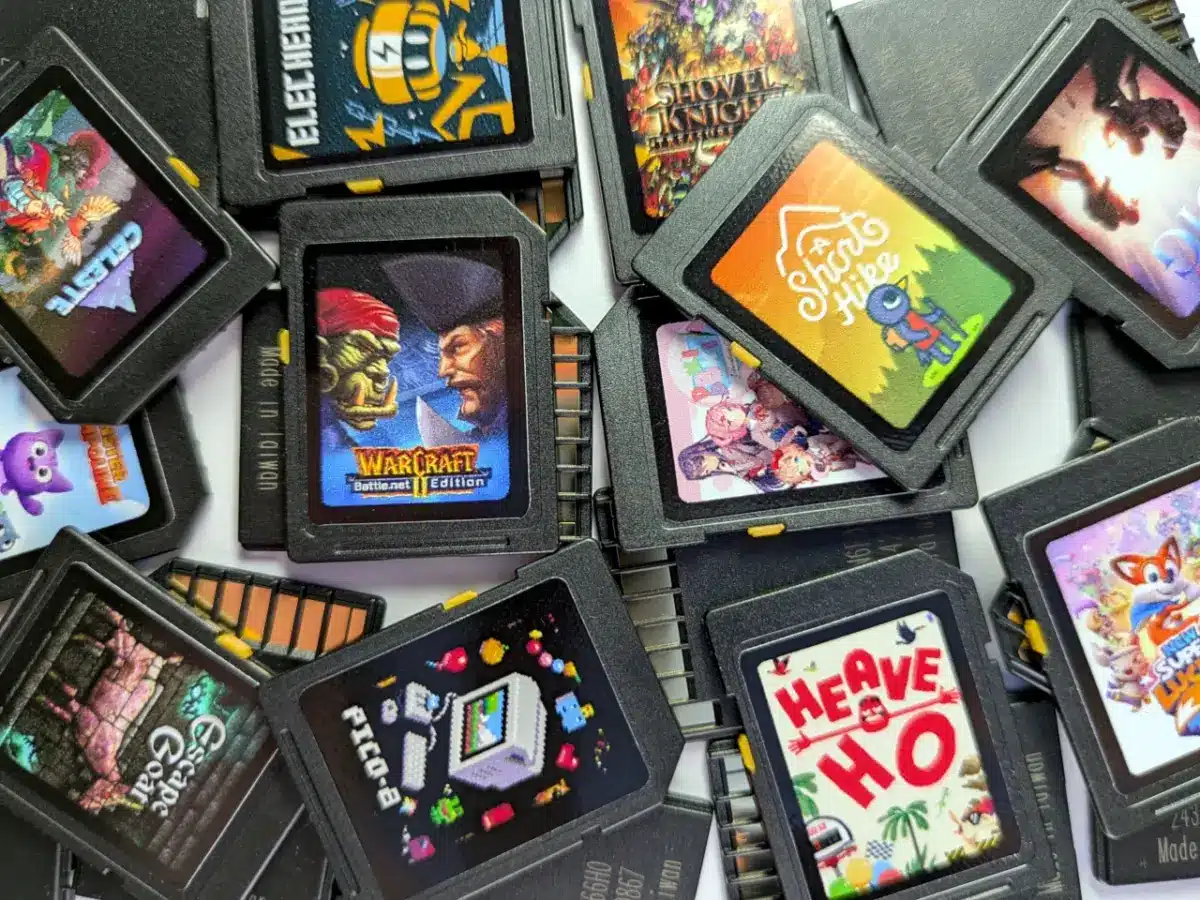
Created by Alesh Slovak, Kazeta is a Linux-based gaming operating system designed to turn a compatible PC, ideally a small machine sitting beneath the television, into something resembling a console from the 1990s. Insert a “cartridge” and play your game. Just like it was Sonic or Virtua Racing back in the day.
The “cartridge” can technically be almost any external storage device, but the project recommends standard SD cards. They are small, consistent, easy to label and, crucially, already look a little like the carts we used to slot into handhelds. They aren’t really a world away from what we have been inserting into the Nintendo Switch for nearly a decade.
This is not simply a decorative card that unlocks a game stored elsewhere. The actual DRM-free game files live on the SD card. Kazeta supports Linux and Windows games, titles bought from DRM-free stores such as GOG and itch.io, and older console games through emulation. There are no launchers, user accounts, subscriptions or required internet connection sitting between the player and the game. Remember those simpler times where you didn’t have to wait for a 1GB patch to download and whip away half your available playtime.
Kazeta is also free and open source, with its code published under the MIT licence. The entire project is built around reducing dependency on companies and services that may not exist in ten or 20 years.
How does Kazeta work?
Kazeta is installed as the operating system on a compatible computer, rather than running as another application inside Windows. When the machine boots, it checks connected storage for a Kazeta Info file with the .kzi extension. That small file tells the system what the game is, where its executable lives and how it should be launched through Gamescope.
A cartridge can also include a Kazeta Runtime file. These runtime images bundle the software needed to run Linux or Windows games, including the Steam runtime and GE-Proton compatibility layer where required. In practical terms, it allows the card to carry not just the game but much of the environment needed to play it.
That is one of Kazeta’s smartest ideas. PC games can break as operating systems, drivers and compatibility tools change. Kazeta attempts to freeze a working version of the game and its runtime together. A little time capsule if you will of a working game.
The card itself remains read-only while the game is running. Kazeta places a writable overlay above it and stores saves on the computer’s internal drive. Remove the cartridge and its game data remains untouched; boot the machine without a card and a retro BIOS-style screen lets you manage saves, playtime and backups.
The operating system is largely immutable too, with most of it locked against changes. Kazeta does not normally connect to the internet and currently has no conventional automatic update system. That sounds restrictive by modern standards, but stability is the point. The goal is to create a machine that still behaves tomorrow as it did today, rather than one that wakes up after an update and suddenly decides your controller, game or graphics driver is unacceptable.
Making a cartridge is not yet entirely effortless. The SD card must be formatted using Linux’s ext4 file system, after which you copy over the game, an icon, the relevant runtime and a hand-created .kzi file. The documentation says a tool for installing games directly onto cards is in development. For now, the final experience may resemble a console, but building the collection remains a hobbyist job for us nerds.
How much does a Kazeta collection cost?
The software costs nothing, but the physical fantasy can become surprisingly expensive.
Kazeta’s official compatibility page currently names the Geekom A5 2025 Edition as its supported mini PC and the 8BitDo Ultimate 2C Wireless Controller as its officially supported controller, although other hardware may work. The Geekom machine is currently listed at £485 in the UK, so building a dedicated Kazeta box from the recommended hardware is not an impulse purchase.
Then there are the cartridges. A branded 32GB Class 10 card currently costs roughly £15 at a mainstream UK retailer. Kazeta says Class 10/U1 is sufficient for most games, although larger modern releases will obviously require 64GB, 128GB or bigger cards. At £15 each, a modest collection of 20 games already represents another £300 before labels, cases or whatever unnecessarily elaborate storage system your brain inevitably invents. Storage is not cheap at the moment, I don’t know if you have noticed.
You could reduce that substantially by shopping around, buying multipacks or using knock-offs cards that pretend to be the real-deal from Amazon, as well as compatible hardware you already own. Even so, Kazeta is not cheaper than placing every game on one enormous SSD. It is deliberately less economical because efficiency is not really the product being offered here.
The product is the ritual.
Why this feels different to another digital library
As I mentioned, I have dabbled with Zaparoo on MiSTer, which uses NFC cards or tags to launch games already stored on the system. It is brilliant fun. Tap a custom card, the correct core and game load, and for a moment a folder full of files becomes something you can hold, organise and choose from.I have been using the Eufymake UV printer to make them beautiful – again, I have a feature coming up very soon.
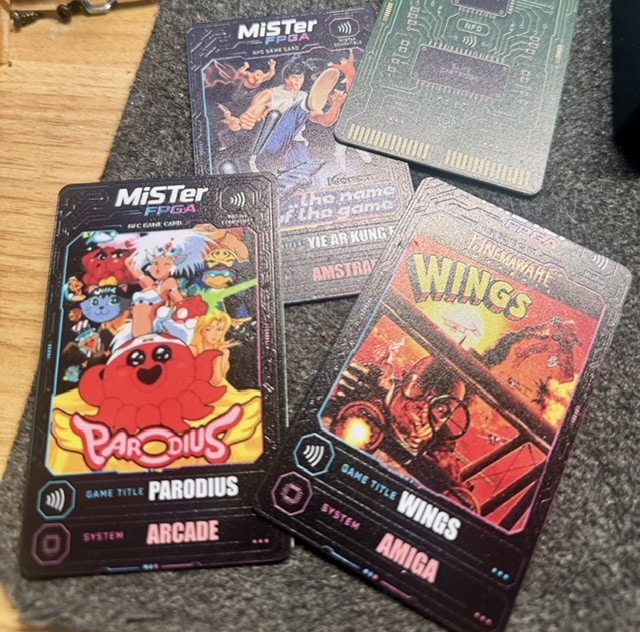
Kazeta takes that idea one important step further. A Zaparoo card is effectively a beautifully dressed command. A Kazeta card contains the game itself and, potentially, the runtime required to play it. That does not magically turn your digital purchase into an officially manufactured cartridge, but it gives the object more meaning. The card is not just pointing at your collection; it is the collection.
Selecting a game from a screen containing 900 tiny cover images does not feel the same as taking something from a shelf, looking at its artwork and physically inserting it into a machine. It should not matter, yet it plainly does.
Music already taught us this lesson. Streaming accounts for the overwhelming majority of listening, but UK vinyl revenue still rose 19.9 percent in 2025 and has now grown for 16 consecutive years. Vinyl is less portable, less convenient and generally more expensive than streaming. People buy it because ownership, artwork, ritual and permanence have value beyond immediate access.
Is Kazeta the future of physical games?
Not really, at least not in the conventional sense.
Kazeta cannot replace a healthy retail market. Its homemade cards cannot be traded into a shop, lent to somebody without a compatible system or placed into an ordinary PC and expected to work. It is limited to games you can obtain without DRM, creating each cart requires effort, and SD cards are not immortal. “Playable forever” is an ambition rather than a lifetime warranty. But the same could also be said for the floppies and cassettes of yesteryear.
It also does not solve the wider ownership problem. Publishers can still stop selling DRM-free games, and most major releases remain locked to Steam, Epic, console storefronts or other account systems. Kazeta works because stores such as GOG and itch.io allow the player to possess usable game files in the first place.
But perhaps asking whether Kazeta can save physical gaming misses what makes it interesting. This is not a replacement for PlayStation discs. It is a small act of resistance against games becoming invisible licences buried inside accounts we do not control.I talk of giving the middle finger to these companies and their incessant drive for profit upon profit. This is a middle finger, perhaps a little one, but it is one.
Sony’s decision illustrates where the mainstream industry is heading. Kazeta shows that the desire for a tangible collection is not disappearing with the disc drive. Players still want shelves, labels, cover art and the reassuring sense that the thing they paid for exists somewhere other than a company database.
Kazeta will probably remain a niche project for people who enjoy configuring Linux, printing tiny labels and spending far too long choosing the correct plastic box. me in other words. And if you are this far down, quite possibly you.
It may not be the future of physical games, but it could be a portion of a future in which we make digital ownership feel physical again. Honestly, I would rather insert a lovingly labelled SD card than scroll past the same game for the hundredth time and care not that I own it.







Categories


Latest News

The Marvel Tōkon: Fighting Souls Open Beta is live right now and runs until July 26th, giving everyone a free 72-hour window to try the 4v4 tag team fighter from…