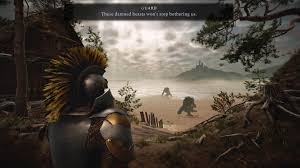
Ever heard of a game called End of Eden? It’s a new Gothic-like developed by indie dev Laughing Fox games, and you may ask – why Gothic, again? Well, as many of our readers know, I grew up with Gothic; it is one of – if not the – most important RPGs I’ve ever played, and significantly shaped the way I view and perceive games as a medium.
It’s that kind of love where you still remember the first time you got humbled by a scavenger, the first time the faction of your choice finally let you join them, and the exact route you took through a world that felt like it didn’t give a damn whether you were ready or not.
The last decade, I have to admit, has been a weird mix of gratitude for the fans (and the mods they lovingly created), and frustration with the gals n boys from Piranha Bytes, who went the way of the Dodo in mid 2024 – sadly, but inevitably.
Piranha Bytes gave us something special way back when, and then slowly showed their inflexible way of creating games, stagnated, and ultimately left a sizeable chunk of Gothic fans left in the dust. We all screamed: “BIGGER ISN’T BETTER”, because the world they created with Elex 2, for example, stopped being as reactive as it used to be, less sensical, and…yes, less Gothic.
All the better, that games like Of Ash and Steel, Drova, and yes, End of Eden carry the spirit of Gothic, even if Piranha Bytes ceased to do so, and are rather content with creating what feels like a UE asset flip in the shape of an Ultima Underworld clone.
Let’s talk about what End of Eden wants to be, and why that’s so important for all the Gothic fans out there, shall we? We shall.
What is End of Eden?
At its core, End of Eden is an open-world, Gothic-like RPG from Laughing Fox Games, planned to release for just the PC in 2027. From the trailers we’ve got, it wears its influence rather proudly, and the pitch the game wants to go for couldn’t be more old-school, but in a good way.
The premise? You arrive unwanted on a cursed island, and you don’t get to be the chosen one just because you clicked “New Game.” You earn ground the hard way, with blood, sweat, tears, and meaningful progression along the way. Hopefully.
Based on what the developers are saying so far (and what’s on its Steam store page, which isn’t much), End of Eden leans hard into:
- Tight melee, archery, and magic as parallel playstyles
- Factions you can join, with the expectation that allegiance matters
- Talents and character growth that feel deliberate, not generic
- Crafting and gear progression are tied to surviving the island
- A living world where NPCs and creatures follow routines
- Tough bosses and quests that are meant to feel meaningful, not disposable
And yes – it’s being talked about in the same breath as Gothic and even the first Risen (arguably) for a reason. A lot of games chase the Gothic label because they want the aesthetic: muddy camps, rough voices, rusty swords, grumpy NPCs. The real Gothic DNA is different. It’s about structure.
Gothic worked because the world felt like a social machine. You weren’t leveling up to power, you were negotiating your place in a hierarchy. The best moments weren’t scripted explosions – they were tiny wins: someone finally respecting you, a camp finally opening up, a shortcut finally becoming safe, stuff like that. Small things, true – but they added to the immersion nonetheless.
End of Eden’s so-called “earn every inch” pitch and faction focus sound like it understands that. It’s not selling a theme park. It’s selling friction, the good kind if we may say so, the kind that makes progress feel like progress, and not just an obstruse stat boost.
And if you’ve been tracking other modern Gothic-likes (which, thank God, exist nowadays) like Of Ash and Steel, End of Eden cuts into the same wood: smaller teams trying to bring back crunchy, choice-driven RPG design without sanding off all the edges. Let’s just hope the game won’t consist of just edges this time around.
We’re Excited for End Of Eden – And You Should be Too
The appetite for more RPGs that lean heavily into the way Gothic and Risen portrayed their worlds is growing, and we’re here for it. Gothic nailed the feel of dangerous exploration, the identification with the several factions, and worlds that don’t revolve around you, and End of Eden is probably trying to do the same.
The problem? Yes, End of Eden doesn’t have to try to reinvent the RPG formula, but it has to find its own identity. The times when the title “xyz-clone” was a positive one are long gone, let’s be real. It just needs to do one thing, it needs to create a world that feels alive, that challenges you in the right way, and react to your actions that don’t feel scripted or arbitrary.
If developer Laughing Fox can deliver even just a solid, focused version of that doctrine, End of Eden won’t be just another Gothic-like, it’ll be proof that the feeling we spoke about at the start of this article can be recreated, without copying everything that made it great in the first place – even if you’re sent to yet another cursed island.
