





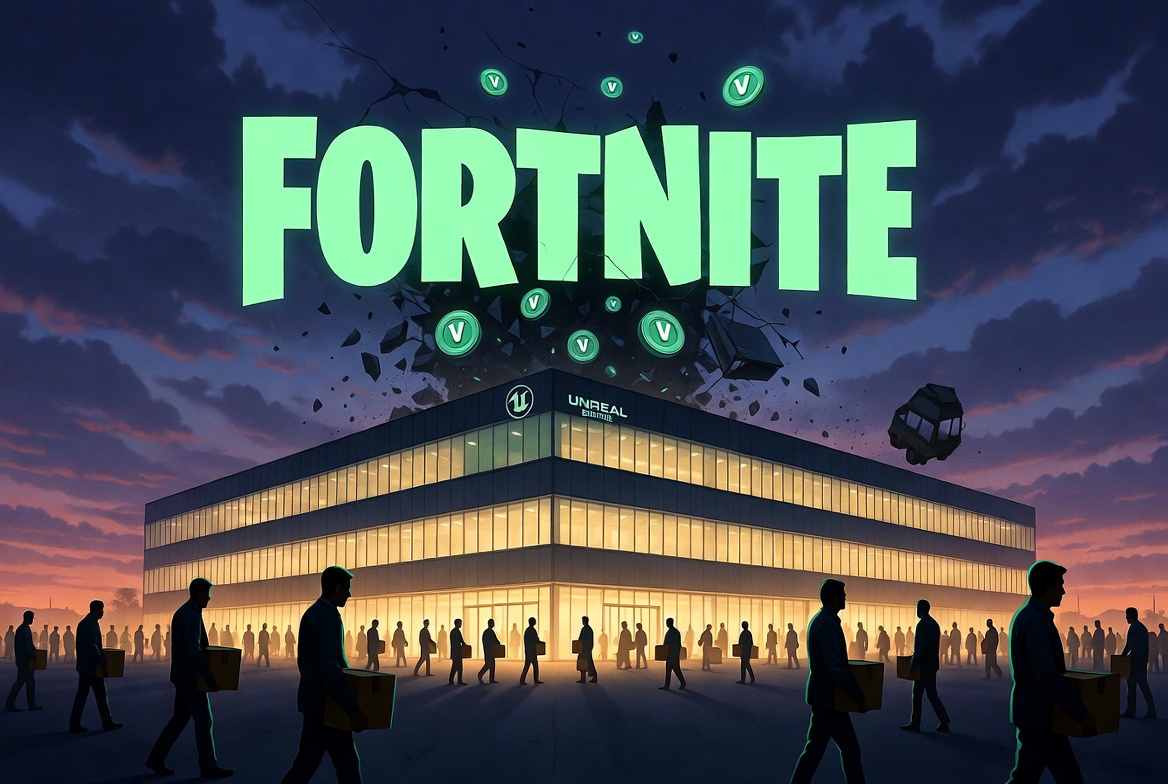
Epic Games, the developer behind the massively popular battle royale Fortnite and the Unreal Engine, has confirmed it is laying off more than 1,000 employees across the company.
This significant reduction comes in response to declining player engagement with its flagship title and broader challenges in the video game industry.
CEO and founder Tim Sweeney addressed staff directly in a public blog post, expressing regret while outlining the tough financial reality.
“We’re spending significantly more than we’re making, and we have to make major cuts to keep the company funded,” he said.
The layoffs represent roughly 20% of Epic’s workforce, leaving the company with approximately 4,000 employees afterward.
The primary driver behind the cuts is a noticeable downturn in Fortnite engagement that began in 2025.
Player time spent in the game has declined — for example, average monthly hours on PlayStation dropped from 21 in February 2025 to 16 in February 2026, with similar trends on Xbox.
Sweeney cited “the most extreme” market conditions in years, including rising competition, weaker consumer spending, and slower console sales overall.
Despite Fortnite still topping US console charts for monthly active users, it has failed to deliver the “consistent Fortnite magic” that kept players hooked in previous years.
Higher development and operational costs, combined with reduced revenue from in-game purchases (leading to a recent V-Bucks price increase), have pushed the company into the red.
This marks the second major round of layoffs in three years — in September 2023, Epic cut around 830 jobs (about 16% of its workforce at the time) for similar reasons.
Beyond the job reductions, Epic is targeting over $500 million in additional savings through reduced contracting, lower marketing spend, and leaving some open roles unfilled.
These measures, paired with the layoffs, are intended to stabilise the company’s finances.
Affected employees will receive at least four months of severance, accelerated vesting of stock options, and six months of extended health insurance.
Sweeney specifically noted that the cuts are not related to artificial intelligence, emphasising a desire for more developers to focus on creating great content.
Despite the challenges, Epic remains committed to Fortnite.
The company plans to rebuild momentum with fresh seasonal content, new gameplay features, story updates, and major live events.
A company-wide meeting is scheduled for later this week to discuss the detailed roadmap.
Longer-term ambitions include “kicking off the next generation of Epic with huge launch plans towards the end of the year.”
This builds on the $1.5 billion investment from Walt Disney Co. in 2024, which supports collaborations featuring Star Wars, Marvel, and Avatar content in Fortnite.
Epic also intends to refocus on mobile optimisation following its antitrust battles with Apple and Google.
Unreal Engine development is expected to continue strongly, as the engine remains a key revenue driver and industry standard.
Epic’s announcement reflects wider pressures facing game developers in 2026, including economic uncertainty and shifting player habits.
Many studios have faced similar belt-tightening, with growth slowing after the post-pandemic boom.
For fans, the news raises questions about the pace of Fortnite updates and potential impacts on other Epic projects.
However, Sweeney struck an optimistic tone, referencing past recoveries: “Each time, we rebuilt our foundations and earned a renewed leadership position.”
The gaming community has reacted with a mix of concern for those affected and hope that the streamlined Epic can deliver the high-quality experiences players expect.
As one of the most influential companies in the industry, Epic Games’ ability to navigate this downturn will be closely watched.
The focus now shifts to how quickly Fortnite can regain its spark and whether the cost-cutting positions the company for stronger growth in the latter half of 2026 and beyond.

Born and raised in Tokyo, I'm a gaming analyst whose obsession began with the Nintendo 64 in 1996. For me, Super Mario 64 wasn't just a game; it was a masterclass in 3D design that shaped my "gameplay-first" critical philosophy. I specialize in bridging Japanese development culture with global trends. When I'm not deconstructing the latest Nintendo hardware, you can find me at Ajinomoto Stadium supporting Tokyo Verdy.

Bulkhead Interactive has announced it is moving WARDOGS' early access release forward, with the tactical FPS now targeting a launch later this summer. The studio cited overwhelmingly positive feedback from…