









I have never been someone who fixates on the thought of extra-terrestrial life beyond Earth, and movies or TV shows that explore those ideas have rarely interested me. I assumed I would feel the same way about SETI, a game about exploring planets and finding alien life. As I moved around the planets, taking actions and playing cards, however, I found that this theme can be enjoyable, at least in board game form.
One of the main things you will be doing in SETI is moving around space with your ship, avoiding asteroids, and landing on planets to perform actions and gain intel.
Planets you arrive at can be interacted with in various ways, such as by launching a satellite to orbit the planet or dropping a probe down onto the planet to dig around and root out information. Your discovery of various things might also provide you with a positive reputation, which will come in handy throughout the game.
These first few actions all revolve around movement and planets, but there is another action you can take which involves doing periodic scans. You can scan in various places around the board, obtaining data as you do, while also allowing you to place your own data discs onto zones you’ve scanned, and taking generic data discs back to your own station.
These generic data discs move to your board and help you move up a track, unlocking a variety of bonuses, as well as allowing you to take further actions. The player data discs you placed on the central board will remain as you work to have the majority of discs in specific areas for later game rewards.

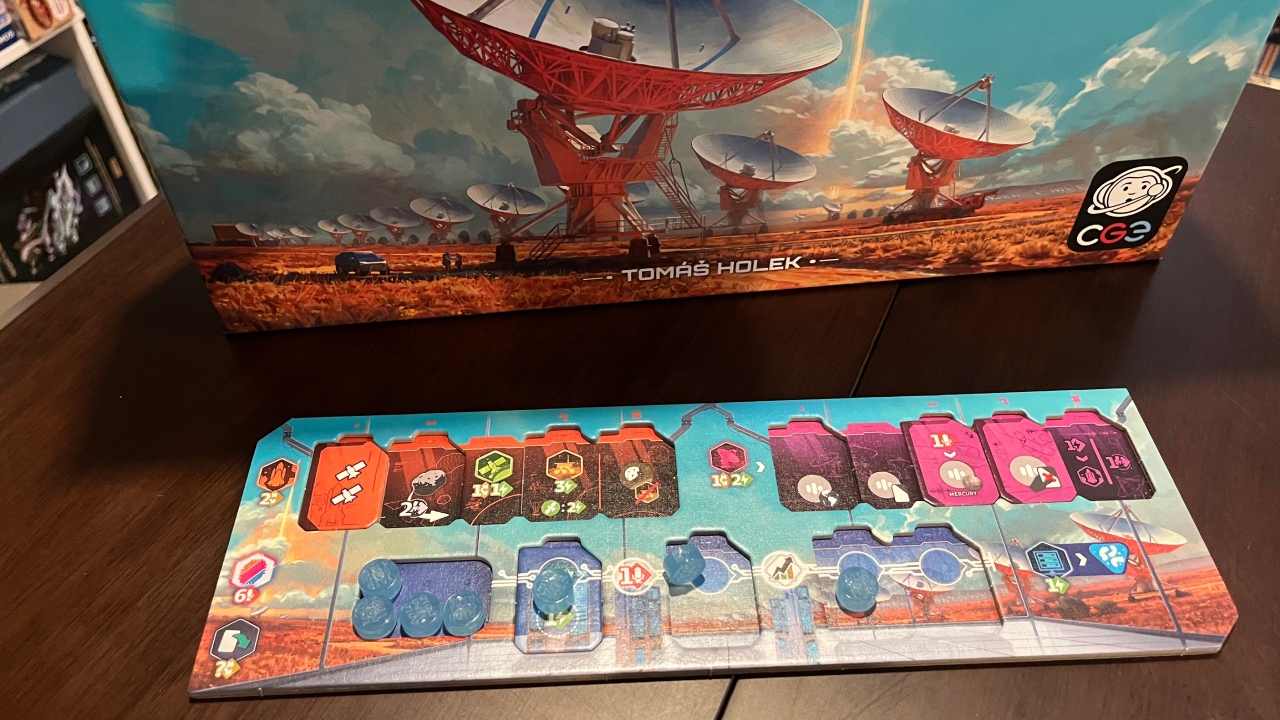
There are only a few actions to think about, but so much more to manage. There is a card and tile economy in SETI that expands your own personal station and makes future actions you take so much stronger.
Tiles improve your tracks, providing more options to choose from on future turns. Cards have many more uses, too. You can pay credits to use a card’s one-time ability or discard the card to receive credits, extra movement, or publicity. You can also choose to tuck cards beneath your stations, providing you additional income on future turns. Moreover, the cards can be discarded in order to scan certain colored sectors of space, depending on the card discarded, that is.
With so many options, how you use your cards is as important as what cards you have. Great cards are only good if used wisely.
SETI is phenomenal, and one of my favorite games of all time, but it does require a significant investment of time and mental capacity.
There is a lot going on in this game, so much so that I think it will overwhelm a lot of people. For those willing to put in the effort and unpack this massive game to play, there are so many satisfying moments.
What I most enjoy about SETI is that you always feel like something is happening on your turn. You never have that boring “Collect Your Workers” action like in worker placement games, or the “Discard and Redraw” actions in card games that feel wasted and unsatisfying. In SETI, it seems that no matter what you are doing, you are getting something cool, unlocking a new ability, finding data, finding aliens, etc. It all feels useful as well, not just getting things for the sake of getting things.

For your first number of plays at least, the most exciting part of SETI is finally discovering the aliens that have made their appearance in your game. The two you use each run are randomly selected from a pool of six, and each will interact with your game in different ways.
They either provide unique ways to score points and/or change how certain aspects of the game play out with new rules and additional things to strategize around. They feel like a mid-game rules modification that players will need to pivot and deal with, and for your first few plays at least, it is incredibly exhilarating.
How that will feel after you’ve discovered all of the aliens is something I cannot comment on as we specifically played our games so that we ended up using all the available options. But even when we did get a few repeats after our third game, the fact that you have no idea which aliens are facedown when the game starts will keep you on your toes. There is no planning for the end game here as so much is tied to the aliens you are researching.

Ultimately, it does mean that the first half of every game of SETI does seem to play out relatively the same, and for some people, that won’t be something they enjoy. I was always fine with it since the second-half payoff was so great.
Even if the first half of the game feels the same, there are so many worthwhile options and strategies to try and use. You can change up what planets you aim for, or what achievements you attempt to finish. There are still options and diverging paths; players just need to take them.
Overall, SETI is a fantastic experience that gets easier with the increasing number of times you play it. While your first experience might be a bit of a let down as you try to wrap your head around the sheer number of options this game provides, the more you play it, the more you will appreciate the brilliance of the design.
SETI is on my list of top games of all time, and for good reason: it is a well-rounded, highly strategic experience.

Adam has been writing about video games since 2014 and board games since 2018. If he's not rooting for the Toronto Maple Leafs or Toronto FC, he definitely has a controller in his hand - probably playing on a Nintendo platform - or is sitting at a table playing a board game. Adam also has firm opinions on a few key topics: there are much better board games than Settlers of Catan, and Nintendo doesn't need to compete with Sony and Microsoft.

Bulkhead Interactive has announced it is moving WARDOGS' early access release forward, with the tactical FPS now targeting a launch later this summer. The studio cited overwhelmingly positive feedback from…