










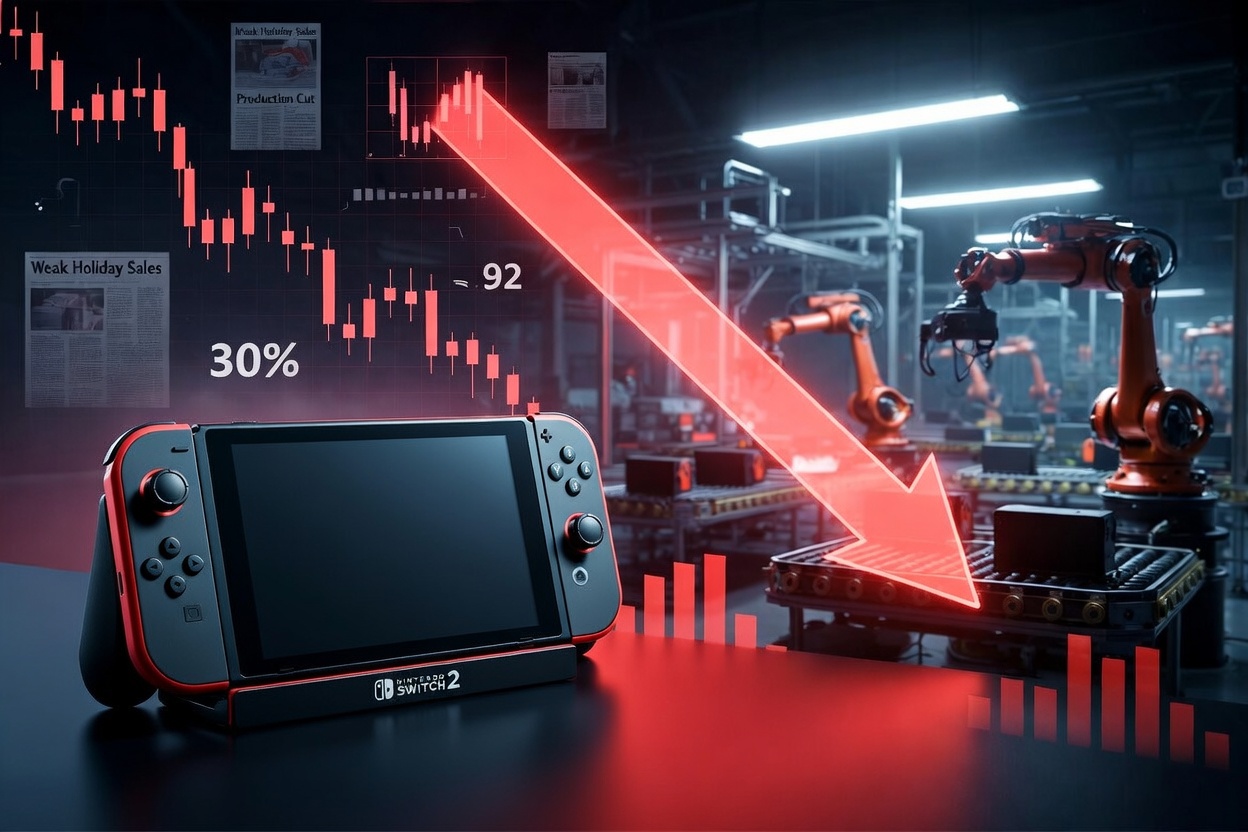
Nintendo has dramatically scaled back Switch 2 manufacturing plans, cutting production by more than 30% for the current quarter following softer-than-expected demand during the 2025 holiday season.
The move, first reported by Bloomberg on March 24, 2026, comes despite the console’s record-breaking launch and highlights growing challenges in sustaining momentum for the hybrid device in key Western markets.
According to people familiar with the matter cited by Bloomberg, Nintendo originally planned to produce 6 million Switch 2 units this quarter but has now reduced that target to just 4 million.
The lower output rate is set to continue into April 2026.
The decision affects the fiscal year ending March 2026, during which Nintendo had already raised its full-year sales guidance from 15 million to 19 million units in November after an explosive debut.
The Switch 2 launched on June 5, 2025, and quickly became Nintendo’s most successful hardware launch ever, moving 3.5 million units in its first four days alone and reaching 17.37 million units sold by the end of 2025.
However, the production cut signals that post-launch demand – particularly in the United States – has not kept pace with internal forecasts.
The primary reason for the cut is clear: holiday sales underperformed expectations, especially in the US.
Bloomberg notes that demand for the $450 console “trailed expectations during the year-end holiday season, particularly in the US.”
This aligns with earlier reports from The Game Business and Circana showing US holiday sales (November–December 2025) down around 35% compared to the original Switch’s performance in the same period after its 2017 launch.
Nintendo President Shuntaro Furukawa acknowledged on the company’s February 3 earnings call that “overseas sales were somewhat weaker than expected.”
Analysts point to several contributing factors: a higher price point than the original Switch, a lack of major blockbuster Western-focused titles during the peak shopping period (Metroid Prime 4: Beyond launched in December but sold under one million copies), and broader economic pressures affecting consumer spending.
While the Switch 2’s debut was stellar – outperforming historical Nintendo launches – the second half of its first year has proven more challenging.
Strong initial demand in Japan for a lower-priced variant helped offset some weakness elsewhere, but US and European momentum slowed noticeably.
Earlier data from NielsenIQ and Circana already flagged holiday softness in the UK (16% lower than original Switch) and the US.
The production adjustment does not appear tied to rising memory chip prices (though those remain a cost pressure).
Instead, it reflects a strategic effort to avoid excess inventory after a post-launch surge that may have pulled forward some sales.
The report triggered an immediate market reaction. Nintendo shares in Tokyo fell as much as 6.3% intraday – the steepest drop since early February – before partially recovering.
Analyst Amir Anvarzadeh of Asymmetric Advisors called the first-year holiday shortfall “awful news,” adding that the software lineup had been “poor, at least until most recently with Pokémon showing some hope.”
He warned of tougher competition ahead, including Grand Theft Auto VI in November 2026.
Many Switch 2 users have expressed disappointment at the news, with some speculating that the lack of a Mario or Zelda holiday title hurt momentum.
Others contextualised the news, pointing to the strong overall first-year sales, economic headwinds, and the importance of the console’s second year for building a developer-friendly install base.
Several commenters noted Nintendo’s history of adapting quickly, citing plans for a new battery-replaceable variant in Europe next fiscal year and potential output increases if upcoming titles like Pokémon Pokopia maintain strong momentum.
Nintendo remains confident in the long-term prospects of the Switch 2 platform.
The company is analysing the slowdown but has not issued an official comment on the Bloomberg report.
Insiders say the production trim is a prudent move to match current demand rather than a sign of deeper trouble.
For gamers, the news suggests supply should remain stable without major shortages, though it may signal a more cautious approach to pricing and software support in the coming months.
With GTA VI on the horizon and higher memory costs potentially leading to price adjustments, Nintendo will need strong first-party releases to keep the Switch 2 flying off shelves.
The production cut serves as a reality check after the hype of launch, but Nintendo’s track record of turning consoles around in their second year (as seen with the original Switch) suggests this could be a temporary adjustment rather than a long-term setback.
As the industry awaits official sales updates in the next earnings report, all eyes remain on how Nintendo responds to keep the Switch 2 momentum alive.

Born and raised in Tokyo, I'm a gaming analyst whose obsession began with the Nintendo 64 in 1996. For me, Super Mario 64 wasn't just a game; it was a masterclass in 3D design that shaped my "gameplay-first" critical philosophy. I specialize in bridging Japanese development culture with global trends. When I'm not deconstructing the latest Nintendo hardware, you can find me at Ajinomoto Stadium supporting Tokyo Verdy.

Bulkhead Interactive has announced it is moving WARDOGS' early access release forward, with the tactical FPS now targeting a launch later this summer. The studio cited overwhelmingly positive feedback from…