




By Paul McNally
There was a point, somewhere between my third broken strum bar and the 900th charity shop copy of Guitar Hero III, when it felt like plastic guitars were gone for good. The rhythm game boom had become one of those weird cultural flashpoints we all apparently agreed to pack away in the loft, along with Wii Balance Boards, Kinect, and the belief that anyone genuinely wanted to air guitar Wonderwall at a house party.
Except, of course, Guitar Hero never really died. It just disappeared into the same strange internet afterlife as LAN parties, CRTs, and people arguing about whether wired controllers are better. The official series may be dormant, but the community has kept the whole thing not only alive, but weirdly healthier than it has been in years.
And in 2026, the hardest part of playing Guitar Hero-style games is no longer finding the software. It is choosing which rabbit hole you want to throw yourself down first.
For years, the biggest barrier to getting back into Guitar Hero or Rock Band was the controller. The games were easy enough to find. The guitars were not. Old Xbox 360 Xplorers and Wii Les Pauls started creeping up in price, dongles went missing, battery compartments corroded, and every second-hand listing became a guessing game called “does this actually work or has somebody’s dog eaten the whammy bar?”
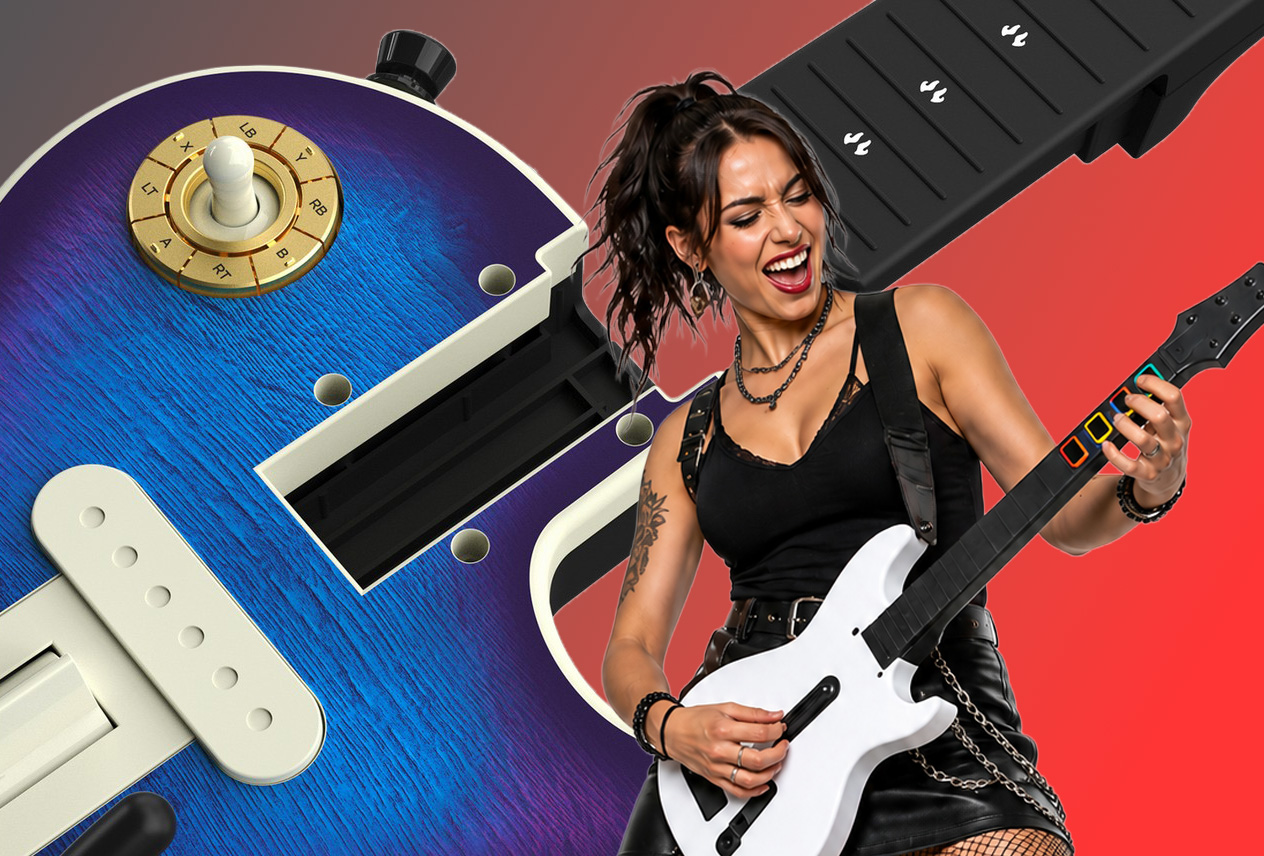
That is why the recent return of proper guitar controllers matters. CRKD’s Gibson Les Paul range is probably the most obvious modern example, because it is shamelessly aimed at people whose muscle memory still lives somewhere around Through the Fire and Flames. The Blueberry Burst Pro Edition includes mechanical fret buttons and a Hall Effect strum bar, while the Black Tribal Encore Edition uses more traditional rubber membrane frets and a mechanical click strum bar. CRKD lists support across PC, Clone Hero, YARG, Fortnite Festival, and various legacy modes depending on model and platform.
There is also the PDP Riffmaster, which is officially licensed, wireless, and designed around Rock Band 4 and Fortnite Festival. The Xbox version supports Xbox Series X|S, Xbox One, and Windows 10/11 PC, while PDP lists Rock Band 4 and Fortnite Festival as supported games. It also has a rechargeable battery rated for up to 36 hours, which is far more sensible than the old days of raiding every TV remote in the house for AA batteries.
The cheapest route, though, might still be an old Wii Guitar Hero controller with a USB adapter. Clone Hero’s own controller wiki notes that Wii guitars can work with a Wii Remote over Bluetooth, or through a wired adapter, and specifically lists options such as RetroCultMods’ Wii/USB adapter, which includes tilt support on its V3 model.
In other words, the hierarchy is pretty simple. If you want the cleanest new-in-box experience, buy a modern CRKD or Riffmaster. If you want the cheapest “serious” setup, hunt down a Wii Les Paul and a decent adapter. If you already have an old 360 Xplorer in a cupboard, congratulations, you have accidentally been sitting on rhythm game gold all this time.
For most people, Clone Hero remains the quickest answer to the question “how do I play Guitar Hero on a modern PC?” It is a free rhythm game inspired by the classic plastic instrument era, available for Windows, Mac, Linux, Android, and iOS, and it supports 5-fret guitars, 6-fret guitars, MIDI drums, standard controllers, and keyboards. It also includes local play, online multiplayer, and leaderboards.
The setup is gloriously unfussy compared with trying to persuade a 2007 console peripheral to behave. Install Clone Hero, plug in your controller, map the buttons, calibrate the audio and video delay, and you are basically there. The important bit is calibration. These games live and die by milliseconds. If your TV has motion smoothing turned on, turn it off. If you are using Bluetooth audio, stop that immediately unless you enjoy missing notes in a way that feels personally targeted.
Clone Hero also remains actively maintained. Its release page lists v1.1.0.6085 as arriving on May 1, 2026, adding features including an input viewer with note trails, a new gamepad mode, and simulated frames. That is worth noting because this is not some abandoned fan executable being passed around a Discord like forbidden treasure. It is a living project.
The big appeal is flexibility. Want to play with a keyboard because you have not yet bought a guitar? Fine. Want to plug in a CRKD guitar and go full nostalgia gremlin? Also fine. Want to use drums? Clone Hero supports MIDI drum kits too. It is basically the “get playing tonight” option.
The only catch is songs. Clone Hero does not magically give you the licensed Guitar Hero catalogue, and this is where people need to be sensible. There are community-made charts, original songs, public packs, and legal homebrew content out there. There are also copyrighted songs and ripped game setlists floating around the internet. You know how that works. Nobody needs me to draw a treasure map to the dodgy island where they are buried.
Clone Hero is the obvious name, but it is not the only one. YARG, short for Yet Another Rhythm Game, is increasingly important because it is chasing more of that full-band Rock Band feeling. It is free, open-source, still in development, and supports five-fret guitar, drums, vocals, pro-guitar, pro-keys, and more.
That makes it especially interesting if your nostalgia is not just for plastic guitar solos, but for the full living room chaos of someone on drums, someone on bass, someone doing vocals badly, and everyone quietly pretending they did not hear the missed high note.
YARG is rougher around the edges than Clone Hero because it is still developing quickly, but that is also what makes it exciting. The v0.12.0 update included improved controller support, SNG song file support, a rewritten score system, menu redesigns, audio calibration changes, and overstrum sound effects for guitar.
If Clone Hero is currently the safest recommendation for most players, YARG is the one I would keep installed next to it. Clone Hero gets you playing quickly. YARG points toward the broader dream: a modern, open-source Rock Band successor that is not shackled to dead storefronts, vanishing dongles, and whatever is left of your Xbox 360 hard drive.
There is also the official route, although it is slightly odd. Rock Band 4 still exists, and Harmonix has said players can continue playing the songs they own, but the weekly DLC era ended on January 25, 2024, after more than eight years of releases. Harmonix also said Rock Band 4’s live services, including Rivals seasons and online play, would continue.
The spiritual energy has clearly moved into Fortnite Festival, which is not Guitar Hero in name, but is absolutely part of the same lineage. It is made by Harmonix, lives inside Fortnite, and uses the familiar note highway format. Epic’s own news page listed a May 23, 2024 update for Pro Lead and Pro Bass in Fortnite Festival, and earlier Festival material confirmed guitar controller support for Rock Band 4 guitars on PlayStation, Xbox, and PC for Pro Lead and Pro Bass parts.
This is the strangest version of the future, really. Guitar Hero did not come back as Guitar Hero. It came back wearing a Fortnite jacket, surrounded by licensed pop songs, battle passes, and children who will never know the emotional trauma of failing Free Bird at 96%.
Still, if you want a supported, current, licensed rhythm game with real tracks and modern hardware support, Fortnite Festival is part of the conversation. You might not like the ecosystem around it, but the actual rhythm game bit is very much descended from the thing we all miss.
This is where things get a little more complicated. If you want to play the original Guitar Hero games in 2026, you broadly have three routes.
The first is original hardware. This is still the purest way. PS2, Xbox 360, PS3, or Wii, original disc, original controller, off you go. It is also the route most likely to involve bad capacitors, dead batteries, missing dongles, and the discovery that your modern TV makes Guitar Hero II feel like it is being played underwater unless you spend 20 minutes fixing lag.
The second route is backward compatibility, where available, but this is not especially helpful for Guitar Hero as a series. The licensing situation, controller requirements, and delisted content make this a mess.
The third route is emulation, and this is where we have to be grown-ups about the word “ROM.” Emulators themselves are not the problem. The problem is downloading copyrighted games and BIOS files from random sites because somebody on Reddit said it was fine. The clean route is to dump your own games and system files from hardware you own.
For PS2 Guitar Hero games, PCSX2 is the obvious emulator, but it requires a PS2 BIOS. PCSX2’s own documentation explains BIOS dumping as a two-step process: modifying the PS2 so it can run a program, then using a BIOS dumper to read the BIOS and write it to an external device such as a USB drive.
For Wii versions of Guitar Hero and Rock Band, Dolphin has its own ripping guide for GameCube and Wii games. Dolphin explains that ripping games and saves using a Wii or Wii U requires homebrew software.
For PS3 versions, RPCS3’s wiki explains that PS3 games can be dumped from physical Blu-ray discs or digital PSN packages, with different processes depending on the format.
That is the version of the answer nobody wants because it is not as convenient as “download a file from a site with 14 fake buttons and a pop-up promising local singles.” But it is the responsible answer. Own the disc. Dump the disc. Dump the BIOS where required. Do not build an article around piracy and then act surprised when the legal goblin appears at the window.
For a normal person who wants to play Guitar Hero-style games now, I would go one of three ways.
The easy modern setup is a CRKD guitar plus Clone Hero on PC. That gives you new hardware, easy configuration, a massive community, and very little faff. If you want something more Rock Band-shaped, install YARG as well.
The console-friendly setup is a PDP Riffmaster with Rock Band 4 or Fortnite Festival. It is not the same as booting Guitar Hero III on a 360, but it is official, tidy, and living-room friendly.
The enthusiast setup is a Wii Guitar Hero controller with a good USB adapter, Clone Hero and YARG on PC, plus legally dumped original games running through Dolphin or PCSX2. This is the “I own cable ties and have opinions about input latency” route, but it is also probably the best bang-for-buck option if you already enjoy tinkering.
A decent PC helps, but you do not need a monster rig for Clone Hero or YARG. Emulation is more variable. PS2 and Wii Guitar Hero games are usually manageable on modern hardware, while PS3 and Xbox 360-era rhythm games can be more demanding or more fiddly. The bigger issue is rarely raw power. It is controller compatibility, calibration, and making sure your audio setup is not introducing enough delay to make you feel like you have suddenly become terrible at a game you used to be good at.
Although, to be clear, that may also happen. Age comes for the wrists first.
Whatever route you take, calibration is the final boss. The original Guitar Hero era was built around CRTs and simpler display chains. Modern TVs, soundbars, Bluetooth headphones, capture cards, AV receivers, and “helpful” picture processing modes all add delay.
Use game mode. Avoid Bluetooth audio. Run the game’s calibration tools. Test with songs you know well. If the notes feel early, late, or just vaguely cursed, it is probably not you. It is the setup.
This matters even more if you are using emulation. You may need to adjust emulator latency settings, controller mappings, audio backend settings, and in-game calibration. It is not difficult, exactly, but it is the difference between rediscovering a classic and deciding your £120 plastic guitar is haunted.
The funny thing is that playing Guitar Hero in 2026 might actually be better than playing Guitar Hero was in 2008. Not officially, obviously. We do not have a new Activision-published Guitar Hero sitting on shelves next to a mountain of boxed guitars. We do not have that strange cultural moment where every student house had one plastic Les Paul and one person who insisted they could play Expert after three drinks.
But we do have better controllers again. We have Clone Hero. We have YARG. We have Fortnite Festival carrying the official torch in the weirdest possible way. We have adapters, community tools, open-source projects, and enough obsessive fans to make sure a fake guitar with five coloured buttons remains one of gaming’s most enduring peripherals.
So yes, you can absolutely play Guitar Hero games in this day and age. You can do it with a brand-new CRKD Les Paul, a Riffmaster, a resurrected Wii guitar, a dusty Xplorer, or a keyboard if you are a chaos merchant. You can play community charts in Clone Hero, full-band experiments in YARG, official songs in Fortnite Festival, and your own legally dumped classics through emulation.
The plastic guitar did not die. It just needed a few years, some USB adapters, and a community stubborn enough to keep strumming.
Paul McNally has been around consoles and computers since his parents bought him a Mattel Intellivision in 1980. He has been a prominent games journalist since the 1990s, spending over a decade as editor of popular print-based video games and computer magazines, including a market-leading PlayStation title. Paul has written high-end gaming content for GamePro, Official Australian PlayStation Magazine, PlayStation Pro, Amiga Action, Mega Action, ST Action, GQ, Loaded, and the The Mirror. He has also hosted panels at retro-gaming conventions and can regularly be found guesting on gaming podcasts and Twitch shows. Believing that the reader deserves actually to enjoy what they are reading is a big part of Paul’s ethos when it comes to gaming journalism, elevating the sites he works on above the norm.

Bulkhead Interactive has announced it is moving WARDOGS' early access release forward, with the tactical FPS now targeting a launch later this summer. The studio cited overwhelmingly positive feedback from…