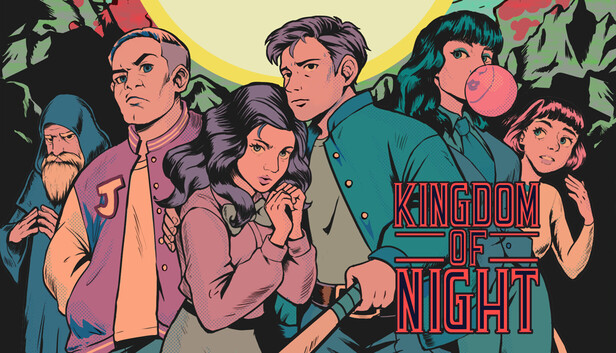
If you grew up watching The Goonies or binge-watched Stranger Things in a single weekend, Kingdom of Night is aiming squarely for your heart.
Released on December 2, 2025, after a very long development cycle that started way back with a Kickstarter campaign, this indie Action-RPG promises a mashup that sounds perfect on paper: the loot-heavy, isometric addiction of Diablo mixed with the moody, small-town cosmic horror of Earthbound.
Developed by Friends of Safety (formerly Black Seven Studios), it’s a game that drips with style and ambition, but sometimes trips over its own shoelaces.
The premise is classic 80s cinema cheese in the best way possible. You play as John, a teenager living in the sleepy town of Miami, Arizona, in the year 198X. One night, a local satanic cult accidentally summons the demon lord Baphomet, your neighbour Ophelia gets kidnapped, and the town goes straight to hell. It’s a “coming-of-age” story where growing up means literally fighting demons with a baseball bat.
Welcome to Miami (Arizona)
The first thing that grabs you is the atmosphere. The game looks fantastic. It uses a pixel art style that feels modern thanks to some gorgeous dynamic lighting. The contrast between the warm, safe glow of a streetlight and the creepy, neon-green corruption spreading through the sewers sets a perfect mood. It really nails that “Suburban Gothic” feel—wandering through abandoned supermarkets and high schools while jamming to a synthwave soundtrack.
Speaking of jamming, the music is a massive highlight. The developers managed to snag Vince DiCola, the legendary composer behind the soundtracks for Rocky IV and Transformers: The Movie. The score isn’t just background noise; it pumps you up and drives the action forward, making even mundane skeleton-smashing feel like a movie montage.
The town itself acts as a large, interconnected map rather than a series of disconnected levels. It feels like a real place that you learn to navigate, unlocking shortcuts and finding secrets in a way that reminds me a bit of Dark Souls or a Metroidvania. It’s fun to just exist in this world, exploring the nooks and crannies of a town under siege.
Class Is In Session
When you start, you pick from five classes: Barbarian, Knight, Rogue, Necromancer, and Sorcerer. But instead of generic fantasy tropes, they are flavored to fit the setting. Your stats aren’t Strength or Intelligence; they are Muscle, Guts, and Wits. It’s a small touch, but it helps sell the idea that you are just a kid tapping into these archetypes to survive the night.
I spent most of my time with the Sorcerer and the Necromancer. The Sorcerer is interesting because casting spells isn’t just a button press; you have to input specific button combinations, almost like a fighting game or Magicka. It adds a layer of complexity that makes you feel like you’re actually weaving magic, but it can be frantic when a dozen demons are clawing at your face. The Necromancer is a blast if you like pet classes, forcing you to manage your health as a resource to keep your giant skeleton buddy fighting.
The skill system uses a “keychain” visual metaphor, which is cute, but the progression is fairly linear until you hit level 10 and can start branching out into subclasses. It takes a while to feel like your build is really coming together.
The “Soulslike” Identity Crisis
Here is where the game might divide people. It looks like Diablo, but it plays more like a “Soulslike-lite.” You can’t just mindlessly spam attacks. Every swing, dodge, and block consumes stamina. The animations have weight and commitment, meaning if you press the attack button, you are locked into that swing until it’s done. You can’t dodge-cancel out of it.
For some, this will feel tactical and tight. Mastering the parry timing to reflect damage back at enemies feels great when you pull it off. For others, it’s going to feel clunky and sluggish, especially when you get swarmed by respawning enemies. It’s a slower rhythm than you might expect from an isometric slasher, and you really have to respect the enemies. You will die, and you will need to use food items to heal because health doesn’t just magically regenerate out of combat.
Couch Co-op and UI Nightmares
One huge plus is the inclusion of local co-op. Being able to play through the campaign with a friend on the couch is a feature that has sadly largely disappeared from PC gaming. It also makes the game significantly easier. Having a tanky Knight draw aggro while a Rogue backstabs everything softens the difficulty spikes considerably and turns the game into a fun, chaotic brawler.
However, the game’s biggest weakness is its user interface and quality-of-life features. The inventory system is a mess. You have a backpack that fills up with loot, but there are no good sorting options. You’ll spend way too much time staring at a grid of icons trying to figure out if that new ring is better than the one you have. Quest tracking is also annoying, represented by a scrolling strip of NPC faces with no clear markers or prioritization. It feels like they were so committed to the retro aesthetic that they kept some retro frustrations that we really didn’t need back.
Also, a warning for completionists: as of right now, there is no real “post-game.” Once you beat the final boss, that’s it. If you want to finish side quests or save more citizens, you need to make sure you have a backup save from before the point of no return. It’s a bit of an oversight for a modern RPG.
Verdict
Kingdom of Night is a game with a ton of heart. You can tell the developers loved the source material—the 80s movies, the classic RPGs, the synth music. When you are exploring a spooky high school gym with a friend, bashing demons to a killer soundtrack, the game is absolute magic. It successfully transports you to that specific time and place.
But it’s also a game that fights you. The inventory management is tedious, the combat can feel unresponsive if you aren’t expecting the stamina limitations, and there are still some bugs (like soft locks and UI glitches) that need patching. It’s a rough gem, but a gem nonetheless. If you are willing to put up with some “Euro-jank” style friction for a unique, atmospheric adventure, this is a night worth surviving.
Pros and Cons
| Pros | Cons |
| Incredible Atmosphere: The 80s “Suburban Gothic” aesthetic is nailed perfectly with great pixel art and lighting. | Clunky UI: Inventory management is a chore with poor sorting, and quest tracking is confusing. |
| Killer Soundtrack: Featuring Vince DiCola, the synthwave score drives the action and nostalgia. | Divisive Combat: The stamina-based, animation-locked combat may feel sluggish to players expecting a faster ARPG. |
| Local Co-op: A rare and welcome feature that makes the game a blast to play with a friend. | No Post-Game: Beating the game locks you out of the world unless you manually backed up a save. |
| Unique Classes: The “Coming-of-Age” stats and unique mechanics (like spell combos) make classes feel distinct. | Technical Bugs: Soft locks and visual glitches (like disappearing inventory) are present at launch. |